Horace Sherman Miller
Text
Once considered a hub for racist activity, Waco served as headquarters for writer and editor Horace Sherman Miller. An avowed white supremacist, Miller perpetuated and propagated racist ideas in the mid-twentieth century. He printed his newsletter, The Aryan Views—White Folks News, in Waco and circulated the publication across the world from 1950 until his death in 1964.
Born in Central Texas in 1901 to Claude Thomas Miller and Lema Yarbro Miller, Horace Sherman Miller grew up in poverty and had an eventful youth. His family moved around the state and out of the country as they searched for opportunities on the railroad. During this turbulent period, Miller’s education discontinued. He never attended high school and began his own career with the railroad at age fourteen. He worked in Smithville until April 1917, when he lied about his age and enlisted in the US Navy during World War I. Discharged in 1919, Miller returned to a job with the railroad. He continued working for railroad companies across Texas for twenty-five years. During that time, Miller married in 1932, but his wife had abandoned him by 1944.
Diagnosed with advanced tuberculosis, Miller began to bounce to various sanitoriums across the country and pursued experimental treatments. By 1949, emaciated and bed-ridden, Miller returned to live with his mother and stepfather, William Norris “Nug” Skinner, in Waco. Once in Waco, Miller began to promote white supremacist ideologies, especially following the 1954 Brown v Board decision. Though considered a shut-in due to his tuberculosis, Miller joined the Ku Klux Klan in 1955 and became a Texas Kleagle or recruiting officer. Following the advice and mentorship of Harry William Pyle, a white supremacist based in Memphis, Tennessee, Miller began organizing and using the status of the Klan to push his message of Aryanism. Eventually, Pyle and Miller split after a dispute over how to pursue white supremacist efforts and their differing ideologies toward Aryanism.
Despite the rift with Pyle, Miller continued using Klan influence to promote his message until 1957. That year, the Grand Wizard of the Knights of the Ku Klux Klan Eldon Edwards rescinded Miller’s membership for failure to create any Klan units in Texas in his two years as Kleagle as well as for Miller’s inclination to promote personal interests. Miller’s agenda and ideas continued to gain momentum, however, especially with the creation of his own mail-order white supremacist group, the Aryan Knights of the Ku Klux Klan. With a typewriter hanging over his bed, Miller began to publish his own newsletter, which featured various titles over the years, including The Aryan Defender and The Aryan Knight Views.
His earlier friendship with Pyle not only aided Miller’s short-term participation in the Ku Klux Klan but also helped him launch the newsletter. Pyle functioned as a mentor, edited his writing, and encouraged the publication of The Aryan Views—White Folks News. By 1952, the newsletter had one thousand subscribers, and over the years, subscriber numbers steadily increased. Though affiliated with various white supremacist organizations, Miller personally funded the newsletter. He produced over one thousand copies of each edition and potentially reached more readers through his encouragement to “Read and pass on, please”—a phrase that concluded each issue. Though Miller complained of financial burden, he continued to publish the newsletter until his death in 1964.
The newsletter featured Miller’s views—his anti-Semitism and anti-Catholicism, opposition to immigration, disapproval of integration and anti-Blackness, anti-communism, and general distrust of the federal government. Miller advocated for states’ rights, praised the Confederacy, and supported white Christian nationalist efforts. While the newsletter featured some of Miller’s personal writing, by 1958, he primarily cut and pasted articles from other white supremacist newspapers. Offering unsubstantiated facts and engaging in fearmongering tactics, Miller insisted that non-white peoples threatened the “white race,” and his ideas permeated across the country and world, particularly in Latin America. The content of Miller’s newsletter struck a chord with like-minded individuals and groups in other countries and served as a catalyst for Klan-type units and white supremacist networks globally. South America and central Europe were rife with such organizations, and countries like Argentina, Chile, South Africa, and Sweden looked to the American Klan as a guide for pushing their own white supremacist agendas.
Miller’s publication spread around the globe by his own distribution as well as through sharing amongst groups, which resulted in greater influence abroad than in the US. Miller printed and mailed over nine hundred issues of the newsletter between 1950-1964. Upon his passing, the mail-order newsletter and sponsoring group died out. Miller donated his collection, including his newsletters, correspondence, and propaganda materials from other countries to The Texas Collection for preservation and future study. While the Aryan Knights of the Ku Klux Klan ceased to exist, Miller’s documents reveal the presence and prevalence of white supremacist ideologies over time and how those forces shape the past and present.
Files

Work from Home
All of Horace Sherman Miller’s writing and newsletter production took place in his room where he had a hanging typewriter and desk set up over his bed. Bedridden from tuberculosis, he rarely left his mother and stepfather’s home and was considered an invalid until his death in 1964. | Source: Courtesy of the Texas Collection; James Michael Davis, “Horace Sherman Miller and the US Klans” (MA Thesis, Baylor University, 1989), Baylor University Texas Collection, Waco, TX.
Tumultuous Time
While on a railroad job in Houston in 1937, Horace Sherman Miller and a woman named Clara Porter were struck by lightning while on a walk. Porter died as a result of the injuries, and Miller believed that the lightning strike caused his tuberculosis, though no medical expert ever corroborated that belief. | Source: Courtesy of the Texas Collection; James Michael Davis, “Horace Sherman Miller and the US Klans” (MA Thesis, Baylor University, 1989), Baylor University Texas Collection, Waco, TX.
Phoning Politicians
Pictured here holding an invitation to the White House from John F. Kennedy, Horace Sherman Miller regularly contacted state, national, and international politicians. He wrote to and called local Waco politicians, state representatives, members of the United States Congress, and global figures, such as Soviet leader Nikita Khruschev and Cuban revolutionary Fidel Castro. | Source: Courtesy of the Texas Collection; James Michael Davis, “Horace Sherman Miller and the US Klans” (MA Thesis, Baylor University, 1989), Baylor University Texas Collection, Waco, TX.
Confederate Enlistment
Miller gained membership to multiple white supremacist organizations during the 1950s. He joined the American Confederate Army and the Christian Nationalist political party in 1952. | Source: Courtesy of the Texas Collection; James Michael Davis, “Horace Sherman Miller and the US Klans” (MA Thesis, Baylor University, 1989), Baylor University Texas Collection, Waco, TX.
Aryan Knights Application
According to a 1957 report from the First National Directory of Rightist Groups, Miller’s Aryan Knights group portrayed themselves as anti-communist and as advocates for states’ rights as they demonstrated white supremacist interests and actions. | Source: Courtesy of the Texas Collection; James Michael Davis, “Horace Sherman Miller and the US Klans” (MA Thesis, Baylor University, 1989), Baylor University Texas Collection, Waco, TX.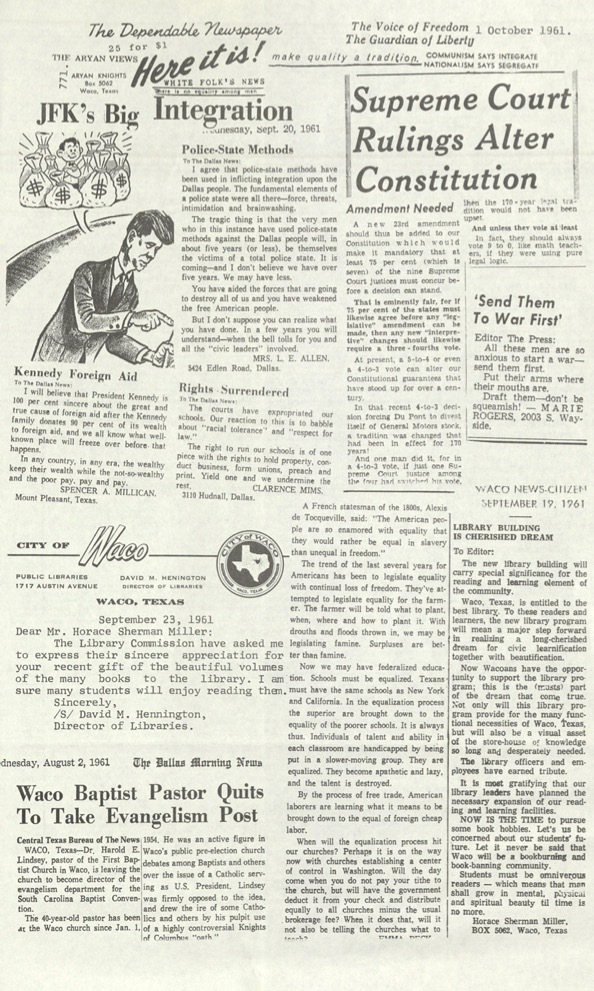
Front Page News
Miller donated his newsletters and other ephemera to the Texas Collection in the 1960s but requested that only he, the CIA, FBI, and archivists have access to the documents. The collection remained sealed for twenty years. Now, after archivist Benna Vaughan processed the collection, there are one hundred twenty-eight boxes of Miller’s writings and other materials available to researchers and the public. | Source: Courtesy of the Texas Collection; Vaughan, Benna. Interviewed by Stephen Sloan, April 26, 2023, Waco, TX. Rogue Media Network, Waco History Podcast. Access full interview here.
Partner in Publicity
While Miller remained restricted to his bed due to illness, William Norris “Nug” Skinner advertised the newsletter and advocated white supremacy in Waco. David F. Smith Jr., Waco’s longest-serving city manager, explains that Skinner attended local council meetings to rant about minority groups in the area. | Source: Smith, David F. Jr. Interviewed by M. Rebecca Sharpless, September 6, 2005, in Waco, TX. Baylor University Institute for Oral History, Waco, TX. Access full interview here.Dialing Discrimination
Arnold Harry Miller, a Jewish man in Waco, recalls that he received a threatening phone call from Horace Sherman Miller when he planned to host a Jewish speaker in his home. | Source: Miller, Arnold Harry. Interviewed by Norma Cannata, April 20, 2014, in Waco, TX. Baylor University Institute for Oral History, Waco, TX. Access full interview here.Unfriendly City
Catholic Monsignor Mark Deering describes discriminatory attitudes in Waco. After all, he notes, the city harbored Horace Sherman Miller and the Ku Klux Klan. | Source: Deering, Mark. Interviewed by L. Katherine Cook, May 20, 2003, in Waco, TX. Baylor University Institute for Oral History, Waco, TX. Access full interview here.Persistent Phone Calls
Abner Vernon McCall, President of Baylor University, remembers that Horace Sherman Miller regularly called his office to discuss materials published in his newsletter. Though McCall reports that very few people paid attention to Miller, at least one thousand people received and read his newsletter regularly. | Source: McCall, Abner. Interviewed by Thomas Lee Charlton and Thomas E. Turner, Sr., March 24, 1982, in Waco, TX. Baylor University Institute for Oral History, Waco, TX. Access full interview here.